Soggy Bottom
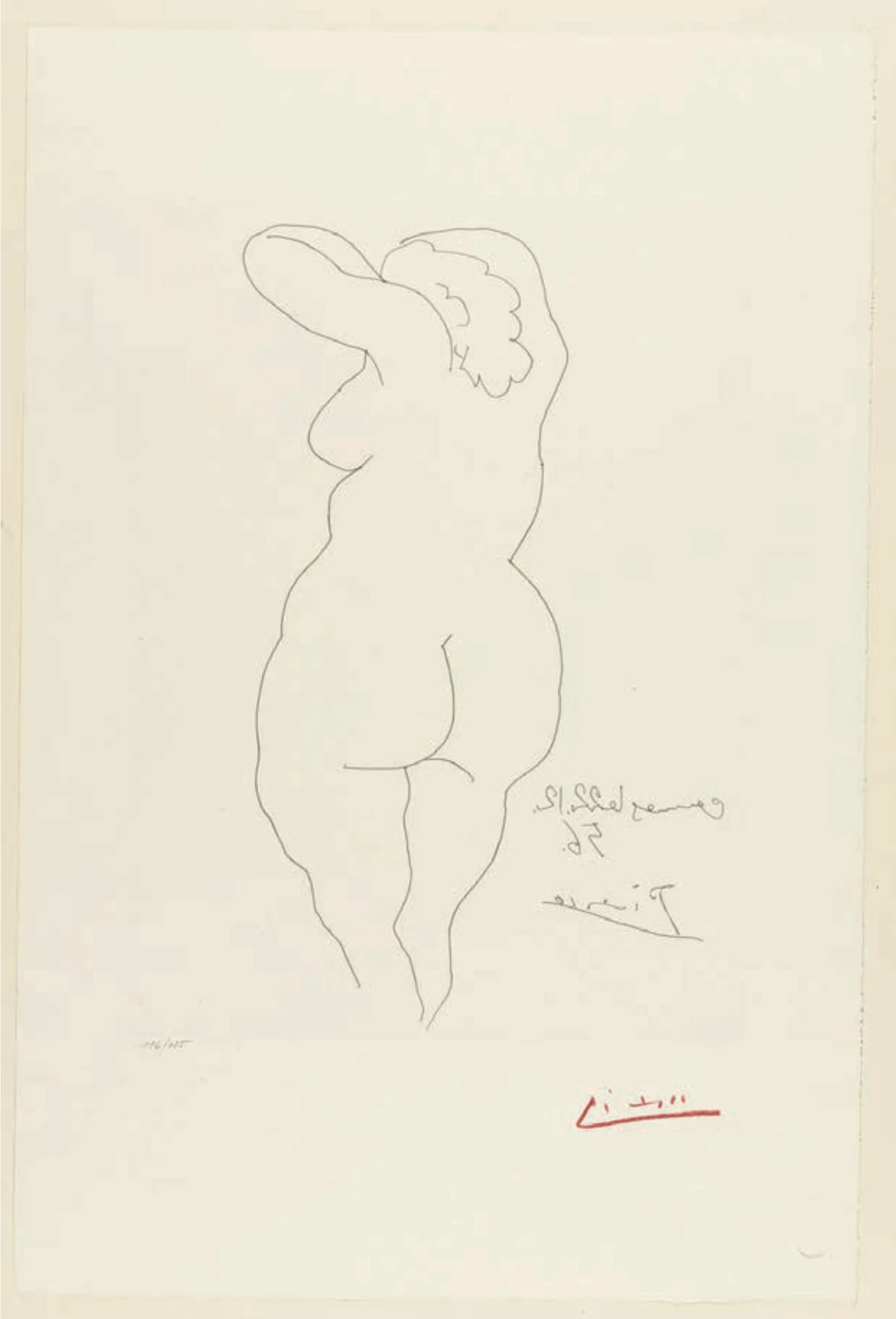
Pablo Picasso, Femme Nue De Dos [Nude Woman Seen from Behind], 1956
Brian doesn’t like the term soggy bottom. “What does it mean?”he asks. Is it Foggy Bottom, the neighborhood in Washington, DC? I didn’t even know that was a thing. Is it a place in Paw Patrol? I just like the sound of it: the way the vowels tuck into the consonants, the repeating letters, the image of a soft underbelly. There are desserts with soggy bottoms: peach cobbler, upside-down cake, bread pudding. For years, Soggy Bottom has been my nickname for my ass. When I take great handfuls of my soggy bottom and lift, I look taut, athletic, ready. Then I let go and Hades descends. A pock-marked, gravity-inflicted mass plummets down on both sides, double cheeks heavy, burdened, sinking. Years of exercise have not touched it. It is the ass in the Picasso poster of a voluptuous naked woman that hung in the upstairs bathroom of my childhood home. My kid brain thought that this woman was my mother, who used to stroll around naked, soggy bottom for all to see. Maybe she was modeling the absence of shame and a proud bush; or, knowing her, it wasn’t deliberate, but unconscious. I stole a glance to see what I would be one day. The Picasso is now in my basement, facing a dark corner of the storage room.
Mom’s soggy bottom is gone. In its place, nothing. Or something, but something I didn’t think of back then. A shit-filled diaper, because there aren’t enough nurses at the home to notice the stink. Two poles rise into a thin, hunched frame. Where once her grace carried her, as if a string ran from the top of her head to her toes, now she’s wilted. Sometimes when I arrive, she’s lying on her twin bed, her near-deaf roommate blasting HGTV or the Blue Jays game, and I think she’s dead. I pause at the door, like I used to when my kids were babies and I thought they would stop breathing, to look for the rise and fall. Her crepe skin is stretched across her high, protruding cheek bones; her arms thin, felled branches on the cheap Amazon coverlet. Next to her is Sally, her dementia-companion cat. Sally used to purr when you pet her, like some real cats, then she’d lick her paw and mew. I’d gotten the robot cat when Mom had spent weeks on the neuro floor after her emergency hematoma surgery. Mom would sit near the nurses’ station, clear tubes draining blood from the drillholes in her skull, with Sally on her lap. Did she think it was real? Did it matter? Now, next to her on the bed, Sally is quiet, matted, and a tripod—who knows where the fourth leg went. There are babies, too: naked dolls that my Mom carries with her. They’re heavy, like my firstborn, with creepy, translucent blinking eyes. They make me want to cry. A mother, still, and yet.
For a woman who used to go camping in full makeup, this is a change. There are no mirrors here, but when I take her out for lunch or a mani-pedi (less spa day, more get-the-caked-shit-out-from-under-her-nails day), I see her stare at her reflection in the car’s mirror. A flash, a rare tremor of Lacanian presence: she can see. There is fleeting clarity in her self-disgust and then, just as quickly, she is gone. She comes back at the next red light. I see her looking once more in the mirror, studying. She looks at me, then looks away and she is gone again. We are in this loop until we reach NewLook Nails.
Her green-blue eyes have no anchor and haven’t for a few years. They are misty, floating, like looking at a stereogram. I should have prepared for this slow receding, but didn’t know how. Only when clearing out the house did I find notebooks filled with pages and pages of reminders, passwords, and transcripts of our phone conversations. I found desperate letters written to her husband, my stepfather, about his affairs. I found poetry. I found unsent birthday cards.
When the disease was getting really bad, she got quiet. Conversations were too fast, and she couldn’t remember the daisy chain of events being recounted. Did she notice? I don’t think so, since noticing also requires memory. This was also the time when my sister and I were forbidden to see her, the stepfather sending us a cease-and-desist letter for trying to get her proper care. Then, apparently, the full decline. Roaming the house at night, moving from room to room. Not eating, Soggy Bottom hanging on for dear life. When we were finally allowed back in, his cancer was everywhere. The ridiculous white carpet was stained, Mom defeated after all of these years of trying to keep it pristine. His hoarding meant cardboard boxes lined the hallway and the living room. A mouse family moved in and shit in every crevice while we moved my mom and the stepfather out. I felt a sick glee dumping his precious WWII videotapes in the “to donate” pile, along with his model-train sets, cookbooks, lusty letters to other women, and hundreds of tiny jars of sorted, unused screws.
Sometimes I wish she was dead, and when I have this thought I feel like the worst daughter on earth. But wouldn’t it be better? A high-school art teacher for thirty-five years, Mom had been single for a decade before meeting the stepfather on a day cruise in Cancun. Seasick, she went below deck and was followed by this rumpled New Jerseyan who had clocked her as a catch. He bought her a Coke and they were married sixteen weeks later. When her dementia really started to rage, he got “senior scammed,” secretly sending $750,000 via QR code to a woman he thought was his girlfriend. All those years of saving—only eating out once a month, always Swiss Chalet, never spending—were for naught. To think her diaper might just be clean now.
But it’s not, and nothing will change. Bitterness will erode my delicate soul if I linger on these crushing thoughts. He lives in the room across the hall from my mother in the nursing home. He’s wheelchair-bound, his feet elevated at all hours. Apparently the cancer is in his bones. And yet, the cops called the other day after finding him at a downtown convenience store sending $3,000 of Bitcoin to a new girlfriend. If my Mother knew, what would she do? Through the unemployment, the affairs, the physical abuse toward us, the hoarding, she’s said he’s the best husband on earth. So perhaps she’d do nothing at all. This, surprisingly, brings me solace. If she chose this man and knew who he was, then I am free from having to carry anger for her.
And anger goes nowhere except in. A sick, piercing drop in my gut; a fiery disgust; smoke in my eyes. I avoid him at the nursing home, even though his dining-room seat is next to my mother’s. If I happen to arrive at lunchtime, I bring my dog and we are forced to wait in the hallway—no animals in the dining room, thank god. Except it’s a menagerie in there: shrieking and moaning and crying and coughing, bodies decomposing and drooling and gaping. The nurses bring around shrink-wrapped display plates instead of menus, and the old people motion toward what they want. When they can’t, the nurses choose for them, dropping the slop where they can reach it. In the hallway, we make friends, since we sit opposite the elevator doors that open, close, open, close with hospital beds and carts and visitors and wheelchairs coming and going. Maya, the dog, is a hit, since she is proof that life exists outside of this.
On the drive home, I cry. Correction: I play dumb and sad stadium music like Coldplay and I cry. There has to be a better way to die a Groundhog Day death. On my last visit, I thought about stealing Mom, taking Sally and her babies and her small suitcase of sheet music and bringing her home. Then I’d give up everything that fills my days and devote my life to her. And yet, be reasonable.
I went to a suburban mall the other day with my friend Iris—a rare occurrence, since shopping IRL is so foreign now. Or even shopping at all, since I don’t need that much. Where bottoms––soggy or not––used to be held taut in luxe spandex blends, this is now apparently “out.” Loose, baggy workout gear is in, and since Iris is a trainer, my trainer, in fact, I follow her lead, as usual. In the changing room, the dread: ass in the mirrors, its self-righteous sogginess, sad and sagging. Is there a way this body could go from battleground to something else? What if Soggy Bottom is my heirloom? Since there is no inheritance, thanks to the evil stepdad, what if this Picasso ass is what anchors me to the generations of women in my family that I’ve never known? No silverware, no Muskoka cottage, just DNA. I sit, like they sat, on their peach-cobbler cushioning, taking a momentary rest before pressing on. Iris and I find our new gear, get coffee, chat. I mentally step back and assess and decide to squeeze the most out of these days. After all, I’m in midlife, before it’s my time to choose the Saran-wrapped dinner that I’ll forget to feed myself.