
Primary Information
Everyday Carry (2025), as seen in the exhibition “Primary Information” at Bradley Ertaskiran, Montreal, alongside copies of the publication in which this essay appears.
When I started out as an artist, I was intent on making things that were “anti-illusionistic.” At the time I wanted directness, to avoid obfuscation, to deny smoke and mirrors and fakery. What you saw was what you saw. I wanted the solidity of a firm foundation, like the predictability of parallel lines or civic holidays. For me, this meant painting backward, like a printmaker: adding layers of pattern and colour over many work sessions, then using tools (rubber combs, spatulas, branches, sponges) to pull away still-wet paint and reveal the layers underneath.
On good days it felt revelatory, since I was in control of the time-lapse landscape of colours and forms, highlighting key moments on the substrate by letting them shine through. Other days it felt like secreted self-obfuscation: that I was hiding or deeply afraid, the opposite of direct, though I never shared this sinking thought with anyone. Early on, I discovered that vinyl, fabric, leather, and pleather were wondrous, their seductive, pre-determined colour and patterns the equivalent of using colour “straight from the tube,” like the macho ’60s painters. I could create physical layers, depth, by obscuring and revealing. I’d paint canvases, then wrap them with mesh or perforated fabric, sometimes cutting windows or slices into that taut and satisfying layer to reveal some of what was underneath.
When stuck on a painting, or just uninspired, I’d take the A train from Clinton Hill to Manhattan’s fashion district and wander through Mood and a few of the dozens of other textile purveyors. Or Brian and I would hop in our $500 Toyota Echo (no A/C, squealing fan belt) and drive the 495 to suburban Long Island and hit up the now-shuttered chain store Joann’s (RIP). I’d get yards and yards of metallic lace and perforated pleathers and jolie-laide prints while Brian followed along with the cart and played FIFA on his phone. Then we’d stop at a frozen-in-time diner; he’d have a veggie burger and I’d have tuna salad and we felt like we were in a movie. It always unlocked whatever was holding me back, thank god.
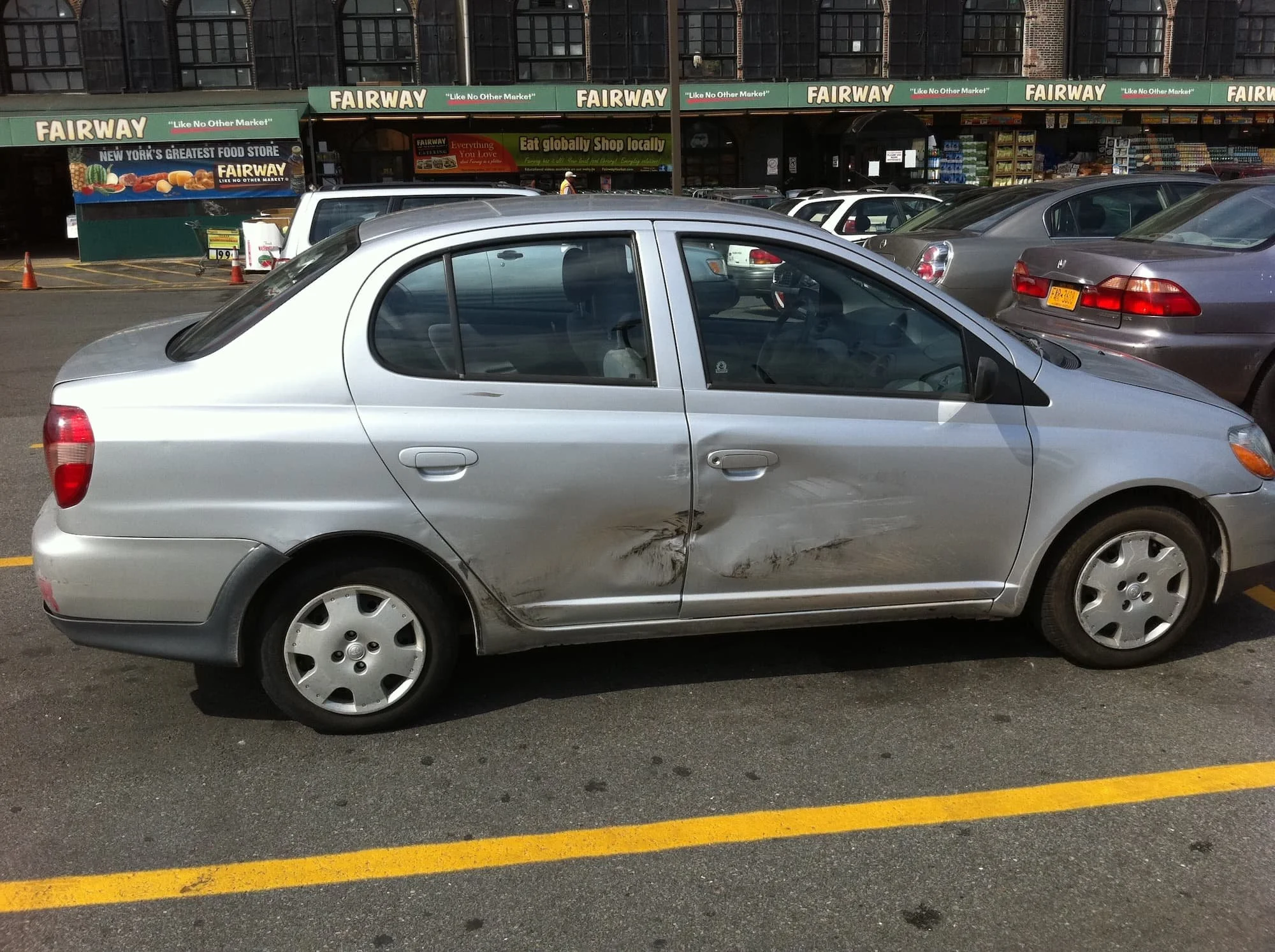
The $500 Toyota Echo
Of course, attempting to be “direct” in my work was not an original idea, and I never suggested as much. Was the directness I wanted equivalent to the Abstract Expressionists? Could their expression be just gestural? Did emotion or emotional state—or the presumption that a viewer could infer such a state—always occlude the gesture? I wanted to capture mark-making and, rather than have it be a conduit for some psychological state, be a trace of a more generalized hand. A true modernist? I wanted to create repeating patterns that would inevitably break down on the painting’s surface because of the human touch. A true postmodernist? I didn’t want to convey my inner world, but rather wanted to relay a presence and series of choices (in what was and wasn’t revealed) that resolved into a (hopefully appealing, hopefully new, hopefully exciting) composition. Then, with the titling, another layer, some way to let slightly more personal information in while anchoring the work in time and space (and a bit of levity): the name of a Milli Vanilli hit (Blame It On the Rain), a favorite breakfast diner in Cincinnati, Ohio (First Watch), a cookie that my dad used to buy as a special treat (Lady Fingers).
The untitled Plexiglas sculptures worked similarly: their date and time stamps conveyed the labour required to make them, yet didn’t relay my emotional state as their maker. The off-the-shelf sheets of brilliant, often-mirrored, seductive, plasticky colour were chosen by me, sure, but not created by me via some passing whim. Like a magpie or like Donald Judd, I was magnetically drawn to the reflective, shiny intensity of the material. The industrial machinery behind the sheets’ production was then transformed by a struggle between my physical capabilities and the material’s inherent characteristics. I was also reading a lot of Arjun Appadurai at the time and loved the idea of the rub between the global movement and circulation of materials and my hyperlocal act of struggling to turn them into useless yet beautiful forms. Of course, when the pieces themselves later circulated through various worldwide biennials and triennials, the materials required to reinstall them were always at hand.
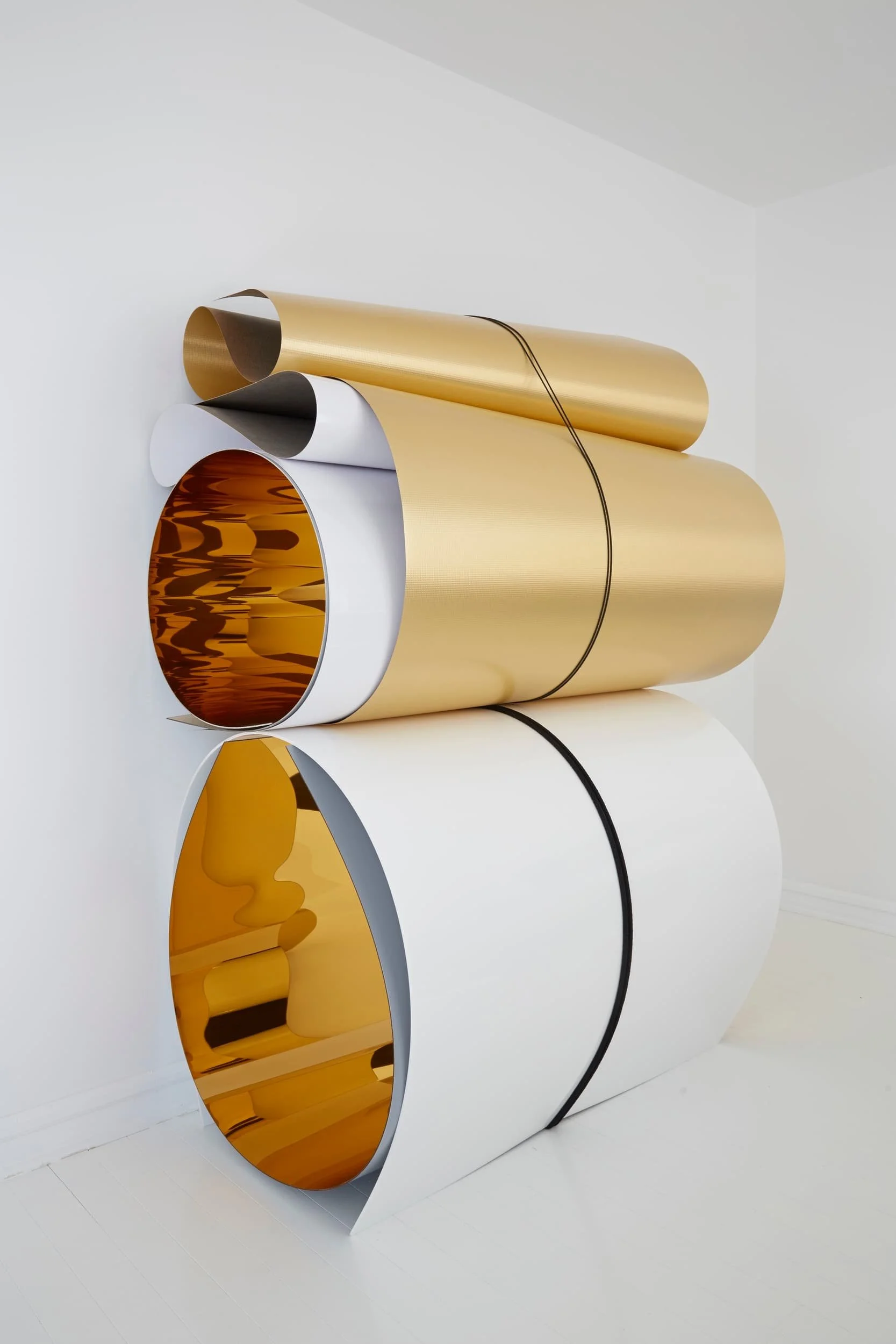
Untitled 32, 11:45 AM–1:15 PM, February 27, 2014
I’ve always seen the sculptures as the meeting point between me and this material—balanced yet securely insecure, the convergence of the hyper-global and hyperlocal. I loved making these pieces and used the term “dirty minimalism,” which I saw as a push against both Judd and his peers and the doomed notion that perfection exists. I would peel the protective film off the colourful four-by-eight-foot sheets and then, while making the sculptures on site, scratch and nick them, creating a story of the effort they required.
Layers and directness appeared in other ways, too—mostly via self-imposed rules, which I established while completing my MFA. For the sculptures: Nothing could be pre-planned, pre-sketched, precut or -drilled. Glue wasn’t allowed, just cotton cord and elastane Everlast wraps, which offered the perfect stretch, width, and give, something I discovered through my short-lived interest in Muay Thai boxing classes (and also, of course, globally available). For the paintings: Their brilliant base layers originated from the self-imposed rule that I could not mix colours, since I was responding directly to what was given. Ironically, it was these rules that set me free and helped me find my creative voice. The overwhelming abyss of the everythingness available within artistic production, the limitless possibility that lay before me as a newly minted artist, would have certainly been my undoing. I found my way through stricture, discipline, and shedding anything that didn’t serve the rule set.
Of course, the thing about self-imposed rules is that the rule-maker can quickly become the rule-breaker. For my 2018 show at Marianne Boesky Gallery, rather than using off-the-shelf Formica, I worked with the company, headquartered in Cincinnati (where we were living at the time), to design my own sheets. The repeating black-and-white pattern had been pulled from a purchased piece of fabric, but still. It was the first time I was not using off-the-shelf materials: rule broken. I also, secretly, started painting wild, un-patterned, not-so-hard-edge underpaintings—gleeful and private images of ejaculating penises and bunny ears and tropical fruit and vintage brooches and snakes with so much mixed paint. Another rule broken. For my 2023 exhibition at Bradley Ertaskiran, I printed photographs that I’d taken of every layer of a giant painting—something I did so I could stare at the images on my phone while falling asleep—as a handsome flip-book. The book was displayed on a shelf next to the painting so that viewers could travel back in time. Suddenly my private universe—full, unedited versions of the painting only ever seen by me—was willfully on display. Rule broken. And it felt … good.
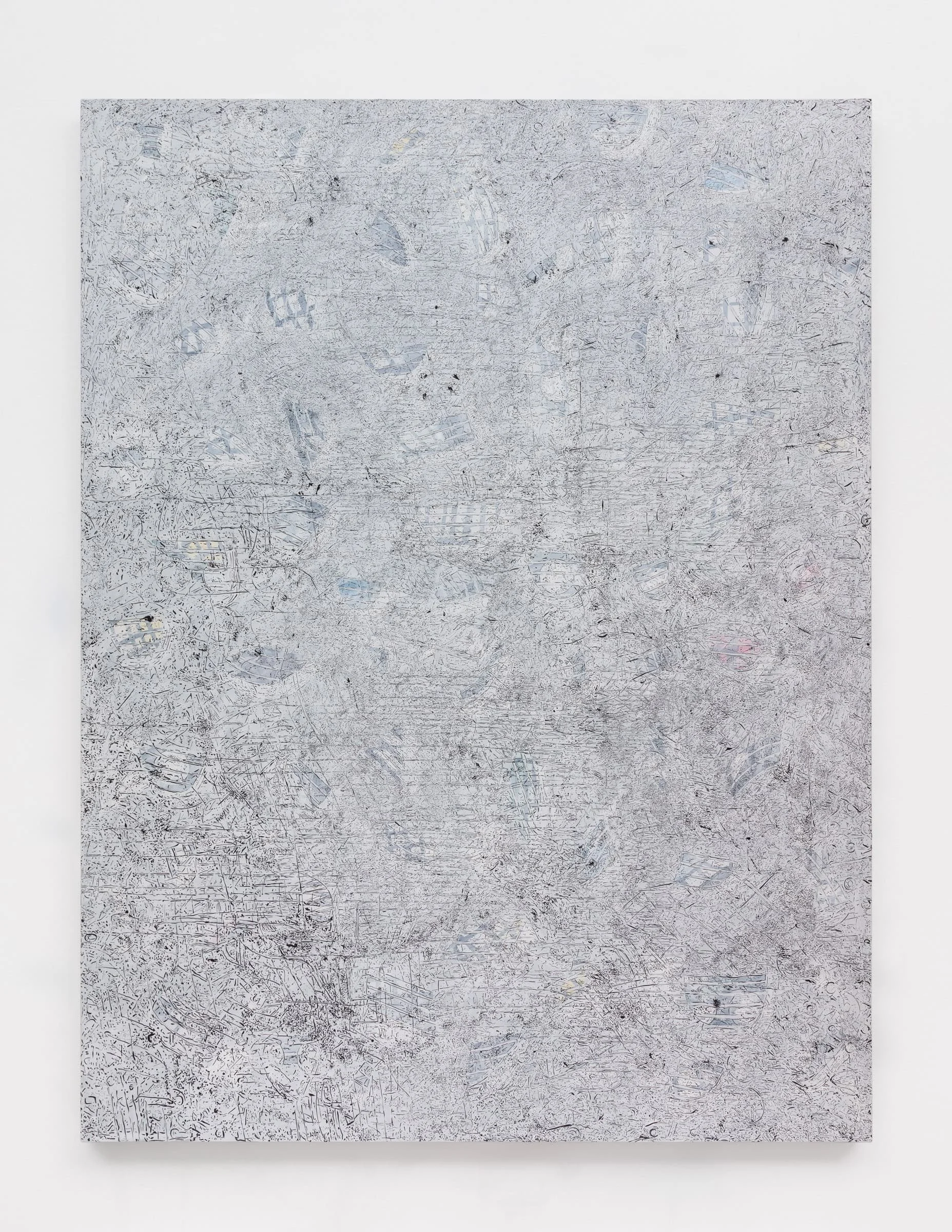
Flashback (2020–22), the painting that is accompanied by a flip-book featuring photographs of the painting taken during the course of its making.
It’s no coincidence that my discovery of the ecstasies of rule-breaking paralleled my deepening experience. I’ve always framed what I do as “experimental”: I asked, over and over, what happens when X tool is used with Y paint over Z layers? What if I use my wingspan to bend a quarter-inch sheet of heavy Plexi and then stack it with rolled Formica, lightly tethered, just so? Experimenting within my established strictures was where I found meaning, joy, and a sense of purpose. It’s also how I saw my own elusive presence reflected back at me—which I needed, desperately. And yet, when I realized I was no longer uncovering the unexpected with the Plexiglas pieces, no longer feeling the thrill of surprise, I ended the series. I think the gallerists were surprised, maybe even disappointed, though they never said as much. After all, these were the pieces that put me “on the map.” Boesky suggested we apply for a project space at Art Basel with a room-size installation of Plexiglas stacks. But that wasn’t what the work was about: there would be no equilibrium there between me and the material, no visible struggle, no directness. My preferred scale, slightly larger than my body, would be gone, as would the viewer’s ability to piece together the private performance. It would just be for show, and thus would be vacuous and trite. So I said no.
Around the same time, the seemingly limitless marks that came from the tools I’d been using to make paintings suddenly felt limited, predictable. With the element of surprise gone here, too, I needed, wanted, to evolve. The hand, gravity, tension, the industrial, reflective materials, extending the viewing experience, production, trace, presence, generosity, directness—I needed these to still be at play. But how?
Around this time, while on a walk with my kids, I heard a shrieking in the trees and looked up to see a red-tailed hawk swooping in on a bird’s nest. Two black birds—the parents, I assumed—were trying to stop the predator from snatching their babies; they were circling the nest and screaming. For weeks and weeks, I thought of this scene repeatedly, oddly seeing it from above, and feeling the parents’ despair. But here was the problem: As an abstract artist, images like these had nowhere to go. I suppose I could break it into its forms or capture its colour palette, but what a waste. I collaged the image from this invented vantage point in Photoshop and had it printed on canvas. I’d popped the contrast and curves and made the baby bird’s eyes unnervingly bright, desperate. It knew it was going to die. And then, like copying the phrasing of one’s favourite writer or tackling a paint-by-numbers composition, I painted the canvas in a way I’ve never painted before: realistically, accurately, blending my oils, capturing the sunlight flickering in tree leaves and detailing the hawks’ menacing descent. The whole time I worked on the hawk, I felt guilty, like painting it was wrong and I was wasting time.
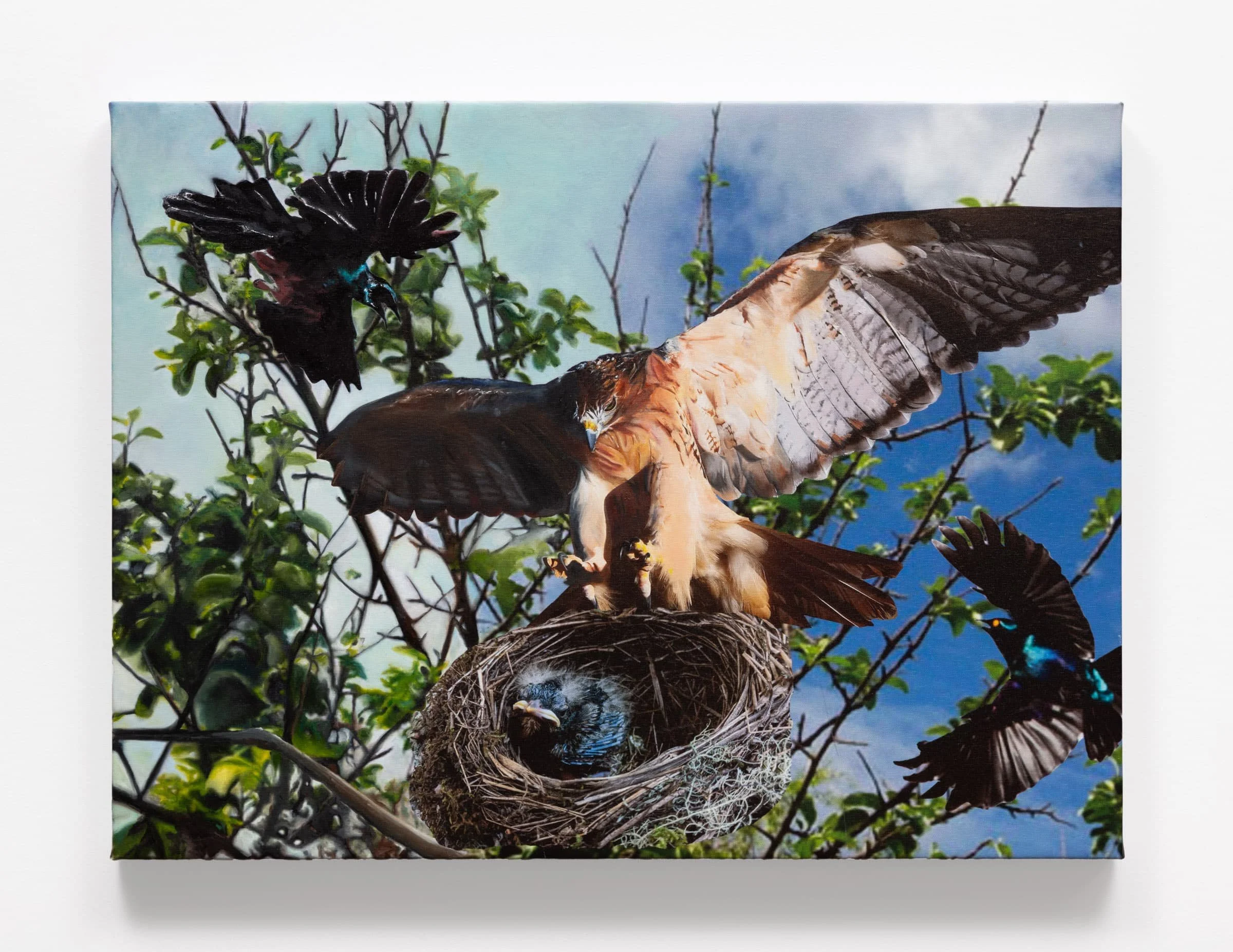
The Hawk Painting (2021–24)
Soon after the painting was completed, I had Zoom meeting with my Montreal gallerists, a regular check-in to see what I was working on. I jokingly held up the hawk painting and told them not to have a nervous breakdown, that I’d been experimenting. We laughed and then moved on and I took them on a tour of the real paintings I’d been working on. The hawk sat on my studio table for months. The scene played out constantly in my mind. I was proud of this fake painting and yet knew that I could never show it. It didn’t make sense with the rest of my practice; my collectors wouldn’t understand it and it would mess with my market value. “Please don’t show us another hawk,” my dealers joked the next time we had a check-in.
And they were right, of course. The hawk was a one-off, a blip. And yet, for me, the hawk had caused a chasm, a change in the weather. I’d never before experienced abstraction—my abstraction—as lacking. And of course it wasn’t just about the hawk. How could I communicate fear and anger and rebellion and disgust and pain and loss and devastation and loneliness and—OK, fine—hope and joy through shapes? I’d painted shapes that eluded language, used marks that could be traced, created double visions through layering, made three-dimensional colour-block sculptures, draped spandex to show time passing, and much more, but suddenly it felt like it wasn’t enough.
I began applying actual paint with actual brushes to the surfaces of my paintings and letting them be. It’s here that my ten-year-old’s voice chimes in: “Well DUH, Mom,” they’d say and roll their eyes. Painting “for real” felt wild and weirdly vulnerable. Wasn’t this the very traditional, very obvious solution to the immediacy I had been searching for? The only problem was that it was too … obvious, too straight. But what if I could do both? Paint like a “normal” painter, yet still get my off-the-shelf patterning through perforated materials, silks, and chintzy rayon blends? Or make sculptures that upended my earlier approach, repurposing industrial materials to make flat drawings with subtle bends and glitches or using a robot arm to make “hand-built” ceramics or attempt to capture the physical and emotional force of human connection in form? A world was opening up, expanding, and the horizons ahead of me exploded with possibility.
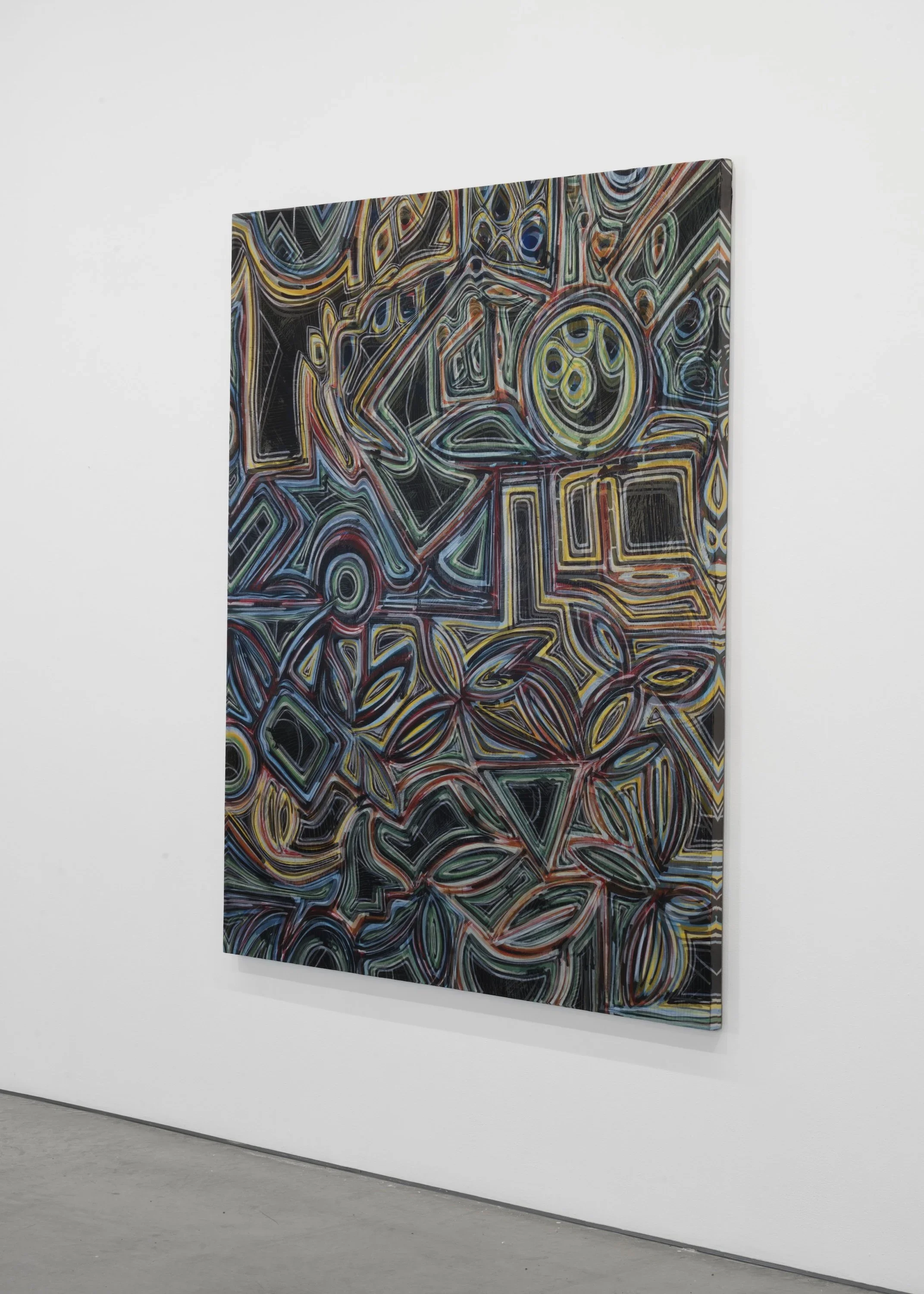
Bigg Boss (2025)
I started having the paintings photographed before they were complete; I’d then finish them and have them framed in earlier versions of themselves printed on spandex, as with Back to the Future II. Or I’d have paintings printed to scale on mesh, which I’d then offset and stretch over the work, so that the finished work looked like lenticular prints or holograms or like Robin Williams in ‘Deconstructing Harry’. This customization was revelatory, empowering. I was here enough to finally have a say: to mix colours, to print my own chintz, to take up space, rather than simply reconfiguring what was in front of me.
The directness I craved when I started out as an artist was a directness of material and of process, and a way to let a viewer, a stranger, in. But what if the frame has changed and I’d been slow to realize it? I was playing catch-up, like when your kid takes a giant developmental leap and you’re left breathless. My old obsession with “anti-illusionism” had served me well, but now that I have almost twenty years of making to buoy me, it has stopped being useful. Biggest rule broken. It’s freeing to think that I can encounter something that moves me and it can, indirectly, appear in alchemical form. I know, I know, artists have been doing this for eons. But I haven’t. My palette has expanded; my mark-making feels deeper, more emotive, satisfying. The richness and complexities of midlife have been hard-earned, so it’s a harder-won magnetism I’m now after. The hawk helped me get here; I’m seeing the changes, the primary information.