Hot Pizza
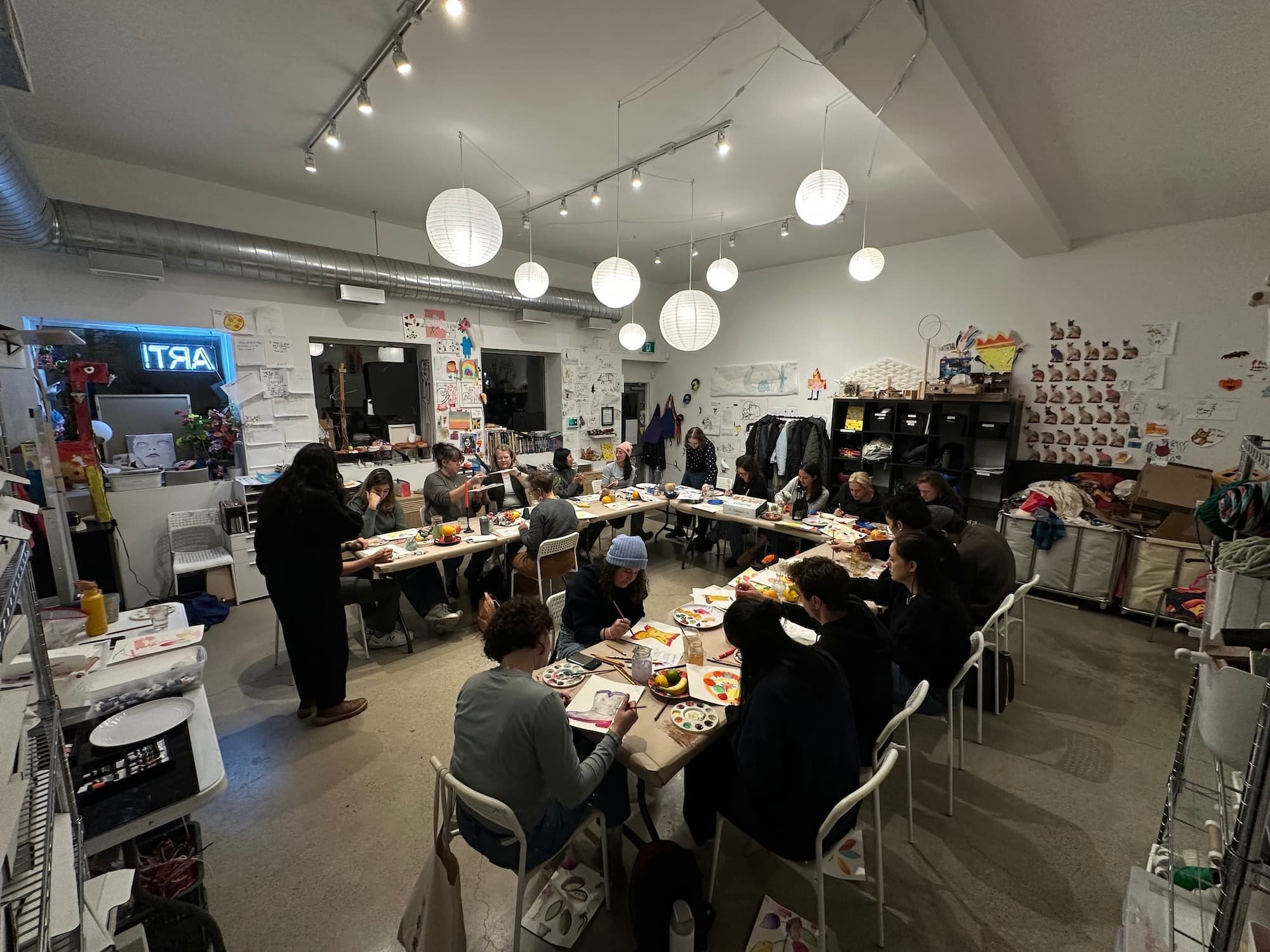
A watercolor class at Hot Pizza, November 2025
It didn’t happen all at once. It wasn’t lightning or vomit or a broken bone. It was more gradual, like the dawning feeling that maybe you should check the map. A series of events led to the crisis: a second baby, a turn toward figuration in the art world, COVID–19, my age. To solve it I figured I had three options: a boyfriend (and I was happily married), a drug addiction (too expensive), or a change. In moments of crisis, I am a keen problem-solver, often jumping to the fix before understanding what needs changing. This time I paused.
I had come out as an artist late, relatively speaking. My “emerging” phase happened not in my twenties, when it’s supposed to; then I was busy producing TV for the CBC and writing art criticism for the National Post. I’d moved to New York at twenty-nine for grad school, in essence restarting, a decision that upended my old life and completely reshuffled, remade, redesigned, rewrote, reconfigured, renewed every day from then on. Man it would have been easy to have not pulled the tablecloth out; everything was set so beautifully. But I needed to.
My dad was a well-known art critic, writing for the Globe and Mail for thirty-five years. (My column in the Post ran on Thursdays, his ran on Saturdays. My editor at the Post joked that he wanted to turn this into a sitcom.) The parallels, though, were a gift that helped me see into the future. As an established art critic, GMD, as he was known, saw art criticism as “secondary” because the writing was wholly dependent on the art; it would not exist, could not exist, on its own. For him, making art, being an artist … now that was primary information, the most pure form of expression: independent, direct, groundbreaking. I’m not sure I ever fully agreed with his theory, but this framing caused my father deep pain. He wanted to be “primary,” wanted to be an artist—and tried. But there was the mortgage, and his vicious moods and anti-authoritarian stance made him unemployable, so he spent most of his life writing about other primary producers and begrudging them their spotlights.
At home, he sometimes painted. The extra room in our dusty old house was his studio, the door always shut, the brushes crispy, dried-up. When he did paint, he preferred acrylics and the dining-room table. He was hurried, noncommittal, frantic, painting on cut-up cereal boxes and in sketchbooks whose pages stuck together with impatience. He used dinner plates as palettes, the ends of brushes to sketch into the gluey colour, and grease pencil to write broken lines of poetry—sometimes someone else’s, sometimes his own. He liked conch shells, spirals, columns. We often painted together, acrylics spread out on the living-room floor. He didn’t care if the paint got on the hardwood, which is unfathomable to my OCD-adjacent self. Sometimes John Scott was there, or Julie Voyce, or Don Jean Louis, Toronto artists all, who were like family to us for a while, until my dad’s cantankerousness drove them away. We’d make Mars Bunnies together, or colour-blocked compositions. Add in weekend trips to galleries so my dad could see shows, and this was what I thought art was: sometimes beautiful, sometimes crushing.
I, too, wanted to be an artist. The co-op I’d lived in on Borden Street had a dry, empty basement, and I’d used it as a makeshift studio, my first. I rolled out large, unstretched canvases and used house paint (found in the garbage) to make my abstractions (man I felt like Pollock). I’d turned down a spot at art school some years prior, since I figured I didn’t know enough to make art. Art history, instead, then writing about other artists. I turned this investigation into my first sculpture: I compiled all of my published writing, redacted any biographical information I’d relied on to explain the art, and had it printed in a hardcover book called Art for Art. This was the first work in my portfolio when I applied to MFA programs.
Eight years in New York, two years in Cincinnati, Ohio (Brian was for a stint the photography curator at Cincinnati Art Museum), exhibitions in London, New York, Marrakesh, Gwangju, Zurich, Toronto, and more. Lectures at RISD, the Guggenheim, the CCA in San Francisco, and more. Art fairs, Basel, Miami, the Armory, and more. Then a baby, a relocation to Toronto to care for my sick mother and to escape Trump’s first term. Show after show, then, after two brutal miscarriages, pregnant again. The New York gallery says they will “tell my collectors that I’m busy working in the studio” instead of the truth, the implication being that no serious artist would have two children. It cuts. I take only five months off and keep working. A creep of emptiness, though, a sense that I am in a churn. Feedback: collectors want to see something new. And yet, too new and it’s too different, too “out there.” I am trapped.
The art world’s turn to figuration, inevitable given the ebbs and flows of taste and fashion, arrives alongside the COVID shutdowns and my second mat leave. I turn to public art and win some competitions, which sustains me during this time. More shows, some online because of lockdowns, and it’s just not the same. Working alone in the studio, some days are peaceful, others deeply isolating. Where are all of the artists here? The artist-mothers? The community? Something is off. Art, for me, has changed.
We visit the Costco Business Centre as a family on Brian’s birthday. It’s a free adventure park with a sideshow of giant vats of mayonnaise and more paprika than you could ever need. Take-out containers, soda-pop fountains, a whole aisle of signs: Open, Closed, Hamburgers, Hot Pizza. The latter is beautiful despite (because of?) its default design—the plainest font, an iconic slice, two mushrooms, three peppers. I make a joke: “Hot Pizza would be such a funny name for something.” I keep mulling it over once we’re home, though. A few days later, I screengrab an image of the sign, build a website, design a tote. I have an idea that, to fight the isolation and deadening sense that art is simply about capital, I’ll find the skill, joy, and purpose of it again. I print postcards, buy tables secondhand from a church I find on Kijiji. I get bulk art supplies and tell our school friends. Hot Pizza’s first session held is in my studio—How to Draw—has four kids in it. One is mine. Our second session, Adult Watercolour, is stacked with my friends. It is so much fun. People beam as they make art for no other purpose than creative expression and joy. It is revelatory.

Julia leading “Hot Pizza to Go,” a gallery tour, in May 2024.
For years I’d been depending on galleries for my income, like many artists. I’d have a show or send them work and then they’d hopefully sell it and send me half the dough. There was no way for me to be in charge of my own income. I felt at the whim of rich collectors—if they wanted the work, if they deemed me a good “investment,” then I’d get a paycheck. This wreaked havoc on my self-esteem: value became a slippery slope. If a painting I loved did not “move” because no one wanted to buy it, it was a failure. I was a failure. There had to be another way.
What started as a lark, a way to take back the joy of making art, has become a deeply community-oriented social art project. Hot Pizza, now in its own dedicated space, employs twenty-six artists and has a bustling after-school program. Kids learn printmaking, realistic drawing, how to take up space with sculpture, collage, storytelling through comics, and more. We teach adults to slow down, appreciate the craft of making, to stop the constant churn of self-critique. I cannot overstate the value this has had for me as an artist and a human. My crisis, I now realize, was a crisis not just of doubting the power of art in this over-commercialized art world, but of isolation: of feeling like art was no longer for the greater good. Free expression felt hampered by market value and long-term portfolios and performance expectations and whether or not you were a “get,” the kind of artist that a collector would breathlessly tell you they had scored through that New York gallery.
It took me a bit and maybe it’s my age, but I now realize that a hyper-global, jet-setting biennial and triennial existence is all good for a bit. But it’s the hyperlocal––truly connecting with people over a shared love of creative expression––that is the most fulfilling. This has solved my midlife crisis, even if it’s hard to balance everything I want to do. I spend the day making work in my studio, then I head to Hot Pizza and watch as artists of all ages overcome perfectionism, master a difficult perspectival drawing, use oil paint for the first time, make mistakes, try. We have T-shirts and have published a colouring book, which we sell to subsidize families and schools who otherwise couldn’t come. We donate to school fundraisers in an effort to combat cuts to education. I never predicted this: that I could both be the artist I always wanted to be and be enmeshed in a community with a shared belief in the power and importance of art. And then, of course, in my own studio, I am more free. More myself. Untethered to capital, to expectations, to whims. And man does it feel good.